Marco MusacchioI study active matter through experiments and simulations, with a nod to theory.
PhD student in theoretical physics
Institute for Theoretical Physics II – Soft Matter, Heinrich-Heine University Düsseldorf
Move your mouse over the particles and they flee; click for a shock wave. The noise η takes the system from an ordered flock to a disordered gas.

I study active matter: systems made of units that consume energy to move by themselves, from flocks to bacteria to small robots.
I am a PhD student at the Institute for Theoretical Physics II – Soft Matter of Heinrich-Heine University Düsseldorf, in the group of Hartmut Löwen. I work on non-equilibrium physics and active matter. Before that I studied at La Sapienza University of Rome, with a Bachelor in Physics and a Master in Biophysics.
What I work on
All projects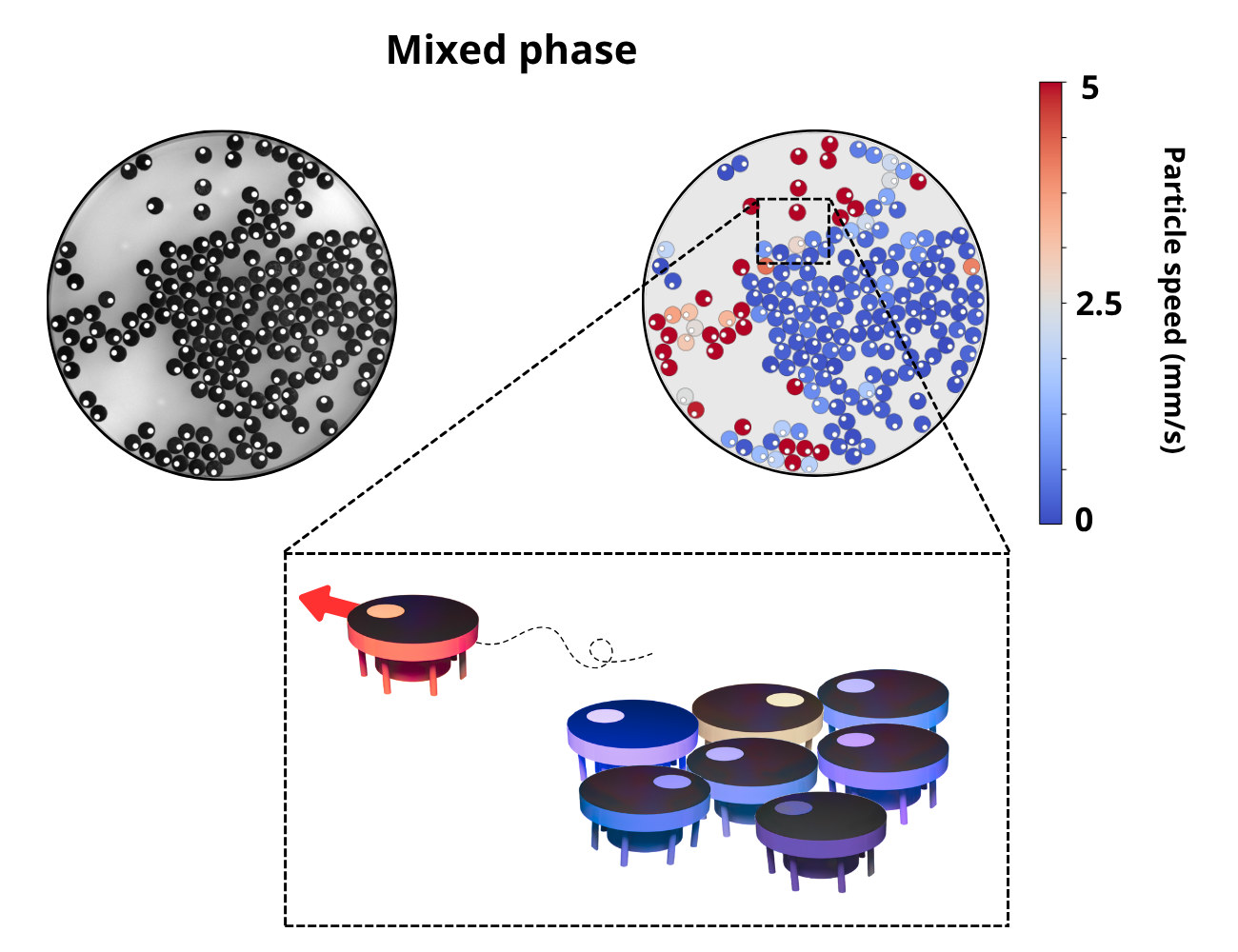 2024-2025
Frictional cooling in active matter
We have identified a spontaneous cooling phenomenon in active matter, termed self-sustained frictional cooling, arising from the interplay between activity and dry friction, without the need for an external thermal bath. Through experiments and simulations on active granular robots, we demonstrate how this mechanism can lead to the formation of dense, arrested clusters, opening new perspectives for controlling the dynamical and structural properties of robotic swarms.
 2025-2026
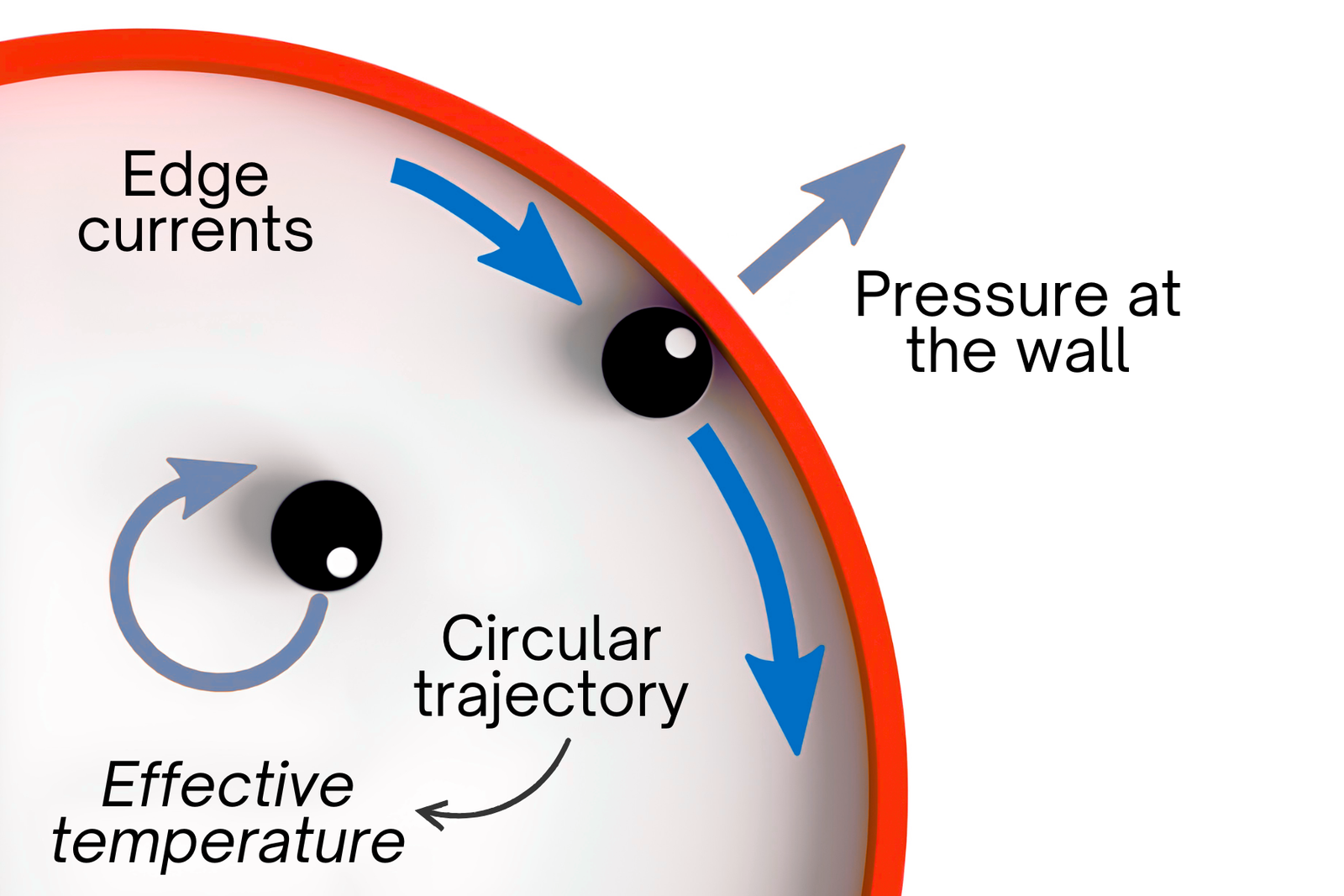
Thermodynamics of chiral particles
We developed a thermodynamic framework for chiral active matter, establishing an equation of state that connects the microscopic properties of rotating active particles to macroscopic quantities such as pressure and temperature. Our findings provide new insights into the collective behaviour of chiral active systems, paving the way for the design and control of autonomous active machines and microfluidic devices.
 2024 - oggi
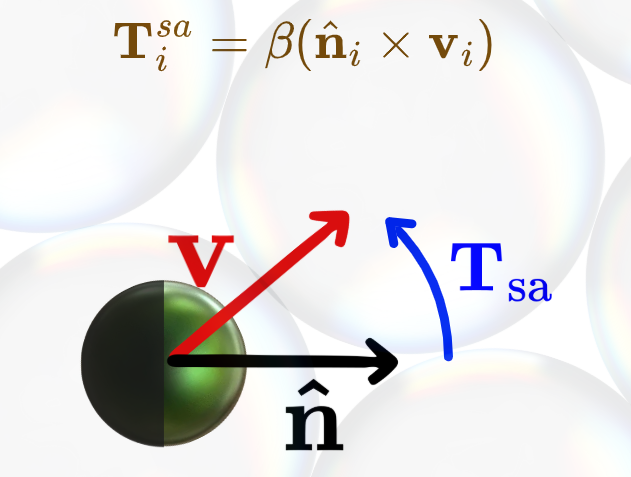
Self-aligning active particles
In active matter systems, the self-alignment mechanism, which aligns the particle orientation with its instantaneous velocity, can profoundly affect collective behaviour. At high densities, sufficiently strong self-alignment suppresses MIPS and induces a transition from a disordered state to a homogeneous flocking state, even in crystalline configurations. In the latter case, the transition can be analytically described within a Landau–Ginzburg theory. The introduction of chirality further enriches the phase diagram, favouring the formation of rotating crystals (circling crystals) and, at higher chirality, vortex-like structures.
 2024-2026
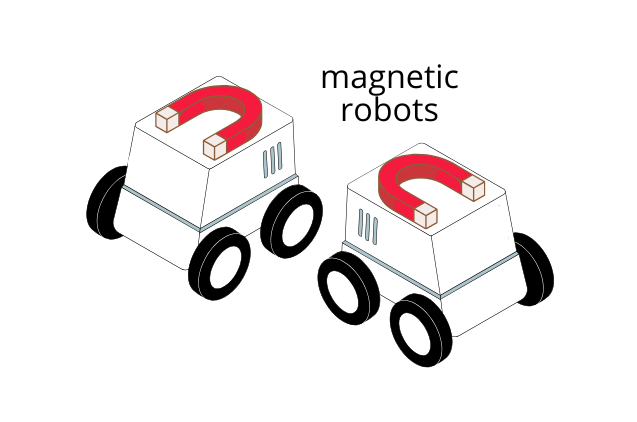
Magnetic active matter
Magnetic active matter investigates out-of-equilibrium systems in which magnetic interactions combine with particle self-propulsion, giving rise to novel collective phenomena and forms of self-organisation. These interactions can profoundly influence system dynamics, modifying clustering processes, structure formation, and transport properties. Studying these systems through experiments and simulations provides insights into how magnetic interactions shape the collective behaviour of active matter across different length scales.
Recent publications
Full list- 2026
Magnetic active matter across scales
Current Opinion in Colloid & Interface Science 102073
- 2026
- 2026
- 2026
Active thermodynamics of inertial chiral active gases: Equation of state and edge currents
Proceedings of the National Academy of Sciences 123 (29), e2532158123